
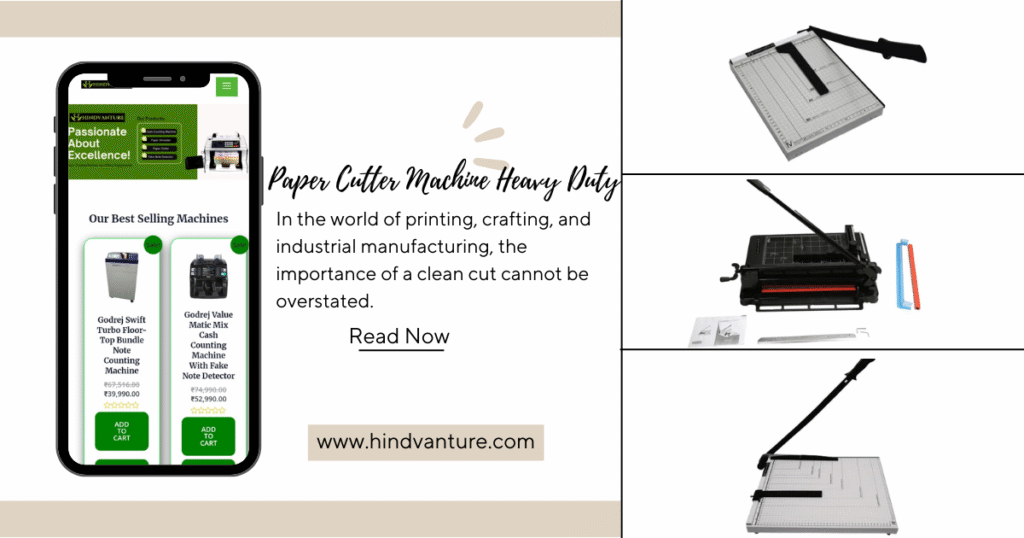
In the world of printing, crafting, and industrial manufacturing, the importance of a clean cut cannot be overstated. Whether you are trimming a single photograph or slicing through a 500-page ream of cardstock, the tool you use defines the quality of your output. Enter the Paper cutter machine—an unsung hero of the office and the print shop.
While it may seem like a simple tool, the modern Paper cutter is a marvel of engineering, ranging from simple desktop trimmers to hydraulic industrial beasts. This guide will take you on a deep dive into everything you need to know about these machines, with a special focus on the Paper Cutter Machine Heavy Duty category for those requiring maximum power.
Table of Contents
- Introduction: More Than Just Scissors
- What is a Paper Cutter Machine?
- The Evolution of Cutting Technology
- Exploring the Different Types of Paper Cutters
- Rotary Trimmers
- Guillotine Cutters
- Stack Cutters
- Slitters and Business Card Cutters
- The Powerhouse: Paper Cutter Machine Heavy Duty
- Hydraulic vs. Electric vs. Manual
- Who Needs a Heavy Duty Cutter?
- Key Features to Look For
- Safety First: Operating Dangerous Machinery
- Maintenance and Troubleshooting
- Conclusion
Introduction: More Than Just Scissors
Imagine printing a beautiful brochure. The colors are vibrant, the design is crisp, and the paper stock is luxurious. Now, imagine ruining that brochure with a jagged, crooked edge because you tried to cut it with handheld scissors.
Precision cutting is the final step in the document creation process, and it is often the most critical. A Paper cutter machine ensures that every edge is straight, every angle is true, and every project looks professional. For businesses, schools, and print shops, these machines are not just accessories; they are vital assets that save time and reduce waste.
In this guide, we will explore the vast landscape of paper cutting technology. From the hobbyist looking for a scrapbooking tool to the industrial manager seeking a Paper Cutter Machine Heavy Duty solution, this article covers it all.
What is a Paper Cutter Machine?
At its core, a Paper cutter is a device designed to cut paper with a perfectly straight edge. However, the mechanism by which it achieves this varies wildy.
Unlike scissors, which use a shearing action between two pivoting blades held by hand, a Paper cutter machine typically utilizes a stable base (the table) and a guide (the fence) to align the paper. The cutting action is delivered by a blade that moves along a fixed path. This stability is what allows for the high degree of accuracy that these machines are known for.
The Anatomy of a Cutter
Regardless of the type, most machines share these components:
- The Base: Usually marked with a grid or ruler measurements for alignment.
- The Blade: The cutting element, which can be a wheel, a lever-arm knife, or a guillotine blade.
- The Backgauge/Fence: A movable guide that allows you to set the paper at a specific measurement.
- The Clamp: A mechanism (manual or automatic) that holds the paper stack firmly in place to prevent shifting during the cut.
The Evolution of Cutting Technology
The need to cut paper dates back to the invention of paper itself in ancient China. However, for centuries, cutting was done manually with knives. The industrial revolution brought about the need for mass production. As the demand for books and newspapers grew, so did the need for a Paper cutter machine that could handle large volumes.
Early machines were massive, cast-iron contraptions operated by large hand wheels. They were dangerous and required significant physical strength. Over the 20th century, we saw the introduction of:
- Electric Motors: Reducing operator fatigue.
- Hydraulics: Providing immense clamping and cutting pressure for Paper Cutter Machine Heavy Duty models.
- Digital Programming: allowing operators to program specific cut sequences for complex jobs.
Today, we have laser cutters and automated slitters, but the mechanical Paper cutter remains the industry standard for straight-line trimming.
Exploring the Different Types of Paper Cutters
To choose the right tool, you must understand the different categories. A Paper cutter is not “one size fits all.”
A. Rotary Trimmers
These are likely what you remember from school or the home office.
- Mechanism: A circular blade sits inside a housing that slides along a rail.
- Best For: Low volume, high precision. Great for photographs, single sheets of paper, and crafts.
- Pros: Very safe (blade is enclosed), cuts in both directions.
- Cons: Cannot handle thick stacks; usually limited to 1-3 sheets at a time.
B. Guillotine Cutters
The classic “chop” style cutter.
- Mechanism: A long, curved blade is hinged at one end. You pull the handle down to slice through the paper.
- Best For: General office use, schools, and copy centers.
- Capacity: Can typically handle 10 to 50 sheets depending on the model.
- Safety Note: Modern versions have blade latches and finger guards, but they require care.
C. Stack Cutters (Ream Cutters)
This is the entry point into the Paper Cutter Machine Heavy Duty world.
- Mechanism: Similar to a guillotine but the blade drops vertically rather than shearing at an angle. They use a long leverage handle or a wheel.
- Best For: Cutting full reams (500 sheets) of paper, cardstock, or even phone books.
- Key Feature: The clamp is essential here. Without a strong clamp, the pressure of the blade would shift the bottom sheets of the stack, resulting in a crooked cut.
D. Slitters and Business Card Cutters
These are specialized Paper cutter machines.
- Mechanism: They use multiple rotary blades set at fixed distances to slit a large sheet into several smaller strips in one pass.
- Best For: Creating business cards, tickets, or coupons efficiently.
The Powerhouse: Paper Cutter Machine Heavy Duty
If you run a commercial print shop, a bindery, or a large corporate mailroom, a standard office trimmer will not suffice. You need a Paper Cutter Machine Heavy Duty. These machines are built to run all day, cutting through thick stacks of difficult materials.
The Mechanics of Heavy Duty
Heavy-duty cutters differ from standard cutters in three main ways: Power, Clamping, and Automation.
1. Hydraulic vs. Electric vs. Manual
- Manual Heavy Duty: You provide the force via a lever or wheel. Good for low-volume heavy cutting (e.g., a small bespoke bookbinder).
- Electric: An electric motor drives the blade and the clamp. This increases speed and consistency.
- Hydraulic: The pinnacle of power. Fluid dynamics are used to generate massive pressure. A hydraulic Paper cutter machine allows for the smooth cutting of dense paper stocks without the “snap” or hesitation sometimes found in electric models.
2. The Importance of the Clamp
In a Paper Cutter Machine Heavy Duty, the clamp is just as important as the blade. When a blade hits a 3-inch stack of paper, the paper wants to move away from the blade.
- Hydraulic Clamping: Allows you to adjust the pressure. You need high pressure for dense paper, but lower pressure for carbonless forms (to avoid marking them) or delicate photo paper.
3. Programmability
Top-tier heavy-duty machines feature digital displays and programmable backgauges.
- Example: If you are cutting a 12×18 sheet into four 6×9 pieces, you can program the machine to move the backgauge automatically after each cut. This creates an efficient workflow known as “cut-push-cut.”
Pro Tip: If you are looking for a Paper Cutter Machine Heavy Duty, prioritize the “cut depth” and “cut width.” Ensure the machine can handle the largest sheet size you plan to buy (e.g., A3, SRA3, or larger parent sheets).
Key Features to Look For
When shopping for a Paper cutter, specifically evaluate these features based on your workload:
1. Cutting Capacity (Sheet Count)
Do not take the manufacturer’s “sheet count” as gospel, as it depends on paper thickness (GSM).
- Rotary: 1-5 sheets.
- Guillotine: 10-40 sheets.
- Stack/Heavy Duty: 300-1000+ sheets.
2. Cutting Width
The throat width determines the widest paper you can insert.
- A standard letter-size cutter usually has a 12-inch width.
- Industrial Paper cutter machines often start at 18 inches and go up to 45+ inches.
3. Backgauge Precision
For professional work, the backgauge must be perfectly parallel to the blade. If it is off by even a millimeter, your square booklets will become parallelograms. Look for machines with a micro-adjust knob for fine-tuning.
4. Blade Quality
High-speed steel (HSS) is standard, but for a Paper Cutter Machine Heavy Duty, look for Carbide blades. They last significantly longer, though they are more expensive to sharpen.
Safety First: Operating Dangerous Machinery
A Paper cutter machine is inherently dangerous. It is designed to slice through dense organic material (paper), which means it can easily slice through skin and bone. Safety is paramount.
The “Two-Hand” Operation Rule
Almost all electric and hydraulic Paper Cutter Machine Heavy Duty models utilize a two-hand operation system.
- How it works: The operator must press two separate buttons simultaneously (usually widely spaced apart) to trigger the blade.
- Why: This ensures that both hands are occupied on the control panel and are nowhere near the blade during the cutting cycle.
Infrared Light Curtains
Modern industrial cutters feature “light barriers” or “light curtains.”
- These are invisible beams of light across the front of the cutting area.
- If an operator reaches through the light beam (for example, to adjust the paper) while the blade is descending, the machine instantly performs an emergency stop.
Blade Changing Safety
The most dangerous time is often when changing the blade. Always use the provided blade changing tool (a handle that screws into the blade) so you never have to hold the sharp edge with your bare hands.
Maintenance and Care
To keep your Paper cutter performing well, regular maintenance is required.
1. Blade Sharpness
A dull blade is a dangerous blade. It requires more force to cut, which strains the motor (or your arm) and can cause the paper to tear rather than slice.
- Signs of a dull blade: A loud “bang” sound when cutting, ridges on the cut edge of the paper, or the blade sticking in the stick.
2. Cutting Sticks
In stack cutters and guillotine cutters, the blade cuts through the paper and slightly into a plastic strip called a “cutting stick.”
- Maintenance: Rotate and flip the cutting stick frequently. If the stick is too chewed up, the bottom sheet of your paper stack will not be cut cleanly.
3. Lubrication
For a Paper Cutter Machine Heavy Duty, the lead screw (which moves the backgauge) and the blade gibs need regular greasing. Consult your manual for the specific type of oil or grease.
Conclusion: The Cut That Counts
The Paper cutter machine is the unsung workhorse of the document world. From the delicate precision of a rotary trimmer used by a photographer to the sheer crushing power of a Paper Cutter Machine Heavy Duty in a commercial bindery, these tools shape the physical media we interact with every day.
Investing in the right cutter is an investment in quality. It saves time, reduces the cost of wasted paper, and ensures that your final product presents a professional image.
Whether you are looking to buy your first Paper cutter or upgrade to an industrial model, remember to prioritize safety, capacity, and precision. The right cut makes all the difference.
Looking for some 639club slot action? This site has got you covered. Variety of games and decent payouts. Definitely worth a spin! You can access it here: 639clubslot
very informative articles or reviews at this time. lüleburgaz taşımacılık